10 Bad Money Habits Keeping You Broke — and How to Break Them
You can make more money and still stay broke.
That's one of the biggest lessons in personal finance.
Give someone earning $40,000 a raise to $60,000 without changing their financial habits, and there's a good chance their lifestyle eventually expands to consume the extra money.
New car.
Better clothes.
More subscriptions.
More eating out.
More shopping.
More payments.
Before long:
More income. Same financial stress.
That's because building wealth isn't only about how much money comes through your hands.
It's also about what happens to the money after it gets there.
Some habits quietly drain $20.
Others drain $200.
And some can cost you tens of thousands of dollars over a lifetime.
The dangerous part?
You've probably repeated some of them so many times that they don't even feel like financial decisions anymore.
They feel normal.
So today we're identifying 10 bad money habits keeping you broke—and replacing them with habits designed to help you build actual financial freedom.
1. Spending Everything You Make
This is the foundation of the paycheck-to-paycheck cycle.
Money comes in.
Money goes out.
Repeat.
If you make $3,000 and spend $3,000, there's nothing left to build with.
If you make $5,000 and spend $5,000?
Same problem.
$10,000?
Same problem.
The numbers got bigger.
The behavior didn't.
That's why increasing your income doesn't automatically create wealth.
Wealth requires a gap between earning and spending.
That gap can fund:
Emergency savings.
Debt payoff.
Investments.
Business opportunities.
Retirement.
Major purchases.
Eventually, financial freedom.
The EBM Fix
Start paying your future self like it's another bill.
Even if it's small.
$25.
$50.
$100.
Automate it whenever possible.
Your first goal isn't becoming a millionaire.
It's breaking the habit of consuming 100% of everything you earn.
2. Buying Things to Impress People
This one is expensive.
People buy:
Cars.
Shoes.
Jewelry.
Phones.
Clothes.
Vacations.
Homes.
Not because they genuinely value them...
but because they want other people to see them owning them.
Here's the problem:
The people you're trying to impress aren't paying the bill.
They see the car.
You see the payment.
They see the vacation pictures.
You see the credit card statement.
They see the new outfit.
You see the Klarna payment next Thursday. 😂
There's nothing wrong with nice things.
EBM isn't about living like a monk.
But buy things because you value them, not because you're trying to create the appearance of wealth.
The EBM Fix
Before making a major purchase, ask:
"Would I still want this if nobody else ever saw it?"
That question can save you a lot of money.
3. Treating Credit Cards Like Extra Income
Your credit limit isn't money.
Read that again.
Your credit limit is not income.
If you earn $4,000 per month and have a $10,000 credit limit, you don't have $14,000.
You have $4,000.
The other $10,000 is somebody else's money that may come with expensive interest if you don't pay it according to the card's terms.
Credit cards can be useful financial tools when managed responsibly.
But they become dangerous when they're used to finance a lifestyle your income can't support.
The EBM Fix
Stop asking:
"Can I afford the payment?"
Start asking:
"Can I afford the purchase?"
Those are two very different questions.
4. Ignoring Small Recurring Expenses
"It's only $9.99."
Dangerous sentence. 😂
Because then you have:
$9.99.
$14.99.
$11.99.
$19.99.
$7.99.
$24.99.
And suddenly you're spending $150–$300 every month on subscriptions and recurring charges you barely use.
That's potentially thousands of dollars per year.
The issue isn't Netflix specifically.
Or Spotify.
Or your gym.
If you use something and it improves your life, cool.
The problem is paying repeatedly for things you've forgotten about.
The EBM Fix
Once every three months, perform a:
Subscription Audit
Pull your bank and credit-card statements.
Look specifically for recurring charges.
For each one, ask:
Do I use it?
Would I sign up again today?
If the answer is no?
Cancel it.
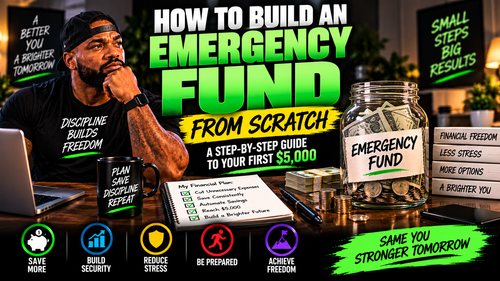
5. Having No Emergency Fund
Without savings, life becomes expensive.
A tire blows.
Credit card.
Car breaks.
Credit card.
Appliance dies.
Credit card.
Unexpected travel.
Credit card.
Then you're not only paying for the emergency.
You're potentially paying interest on the emergency.
That's how one $800 problem can follow you around for months.
The EBM Fix
Build in stages.
Goal #1: $500
Then:
Goal #2: $1,000
Then work toward a larger emergency reserve based on your household expenses, job stability, and financial circumstances.
Your emergency fund isn't sitting there "doing nothing."
It's doing something extremely important.
It's keeping emergencies from becoming debt.
6. Letting Every Raise Become a Lifestyle Upgrade
You finally get a raise.
Let's say it's an extra $500 per month after taxes.
Great.
Then:
New car payment: $350.
Extra eating out: $100.
Another subscription: $25.
Shopping: $75.
Congratulations.
The entire raise is gone.
This is called lifestyle inflation.
And it can keep people financially stuck even as their careers improve.
The EBM Fix
Whenever your income increases, decide beforehand what percentage you'll keep.
For example:
You receive an extra $500.
Maybe:
$250 → investing/saving
$150 → debt or another financial goal
$100 → lifestyle
Now you get to enjoy some of your progress while still moving forward financially.
That's balance.
7. Waiting Until "Later" to Start Investing
Later is dangerous.
"I'll invest when I make more."
"I'll start next year."
"I'll worry about retirement when I'm older."
Then five years disappear.
Then ten.
One of the biggest advantages investors can have is time, because compounding has more opportunity to work over longer periods.
That doesn't mean everybody should blindly throw money into investments tomorrow.
High-interest debt, emergency savings, employer benefits, taxes, risk tolerance, and other factors matter.
But once your financial foundation supports investing, waiting indefinitely has a cost.
The EBM Fix
Learn the basics.
Understand retirement accounts available to you.
Understand diversified investing.
Understand fees.
Understand risk.
Then create a strategy appropriate for your circumstances.
You don't need to become Warren Buffett.
You need to stop letting:
"I don't understand investing."
become a permanent excuse for never learning.
8. Depending on One Income Stream Forever
For many people, a job will remain their primary income source.
Nothing wrong with that.
But there's risk in having your entire financial life dependent on:
One employer.
One paycheck.
One industry.
One position.
If that income disappears, everything gets shaky.
That's why building additional income streams can be powerful.
The EBM Fix
Don't try to launch seven businesses next week.
Build one additional income stream.
Maybe:
Freelancing.
Overtime.
Consulting.
A weekend service business.
Digital products.
Content creation.
Selling a skill.
Gig work.
An online business.
A small local business.
Investments over time.
Your first goal might simply be:
Make an extra $100.
Then $500.
Then $1,000.
Small income streams can grow.
But they have to exist first.
9. Using Extra Money Without a Plan
Tax refund hits.
Spent.
Overtime check.
Spent.
Bonus.
Spent.
Side-hustle money.
Spent.
Birthday money.
Spent.
Then you look back and think:
"Man, I made a lot of extra money this year. Where did it go?"
That's what happens when extra money doesn't have a mission.
The EBM Fix
Create your rule before the money arrives.
For example:
EBM EXTRA MONEY RULE
50% — Financial goal
Debt, mortgage, emergency fund, etc.
30% — Wealth building
Investing or business.
20% — Enjoy it
Your percentages can be completely different.
The principle is what matters.
Decide before dopamine decides for you.
10. Refusing to Look at Your Finances
This may be the most destructive habit of all.
You don't check your bank account.
Don't open credit-card statements.
Don't know your debt balance.
Don't know your interest rates.
Don't know your monthly expenses.
Don't know your net worth.
You just know:
"I think I'm doing okay."
Nah.
We need numbers.
Financial avoidance creates anxiety because you're constantly afraid of something you haven't measured.
Sometimes the truth is uncomfortable.
But the truth gives you something powerful:
A starting point.
The EBM Fix
Once a week, have a 15-minute:
Money Meeting
Pull everything up.
Check:
Bank balances.
Upcoming bills.
Credit cards.
Savings.
Debt.
Income.
Spending.
Investments.
Nothing fancy.
Just look at the numbers.
Your money should never know more about your financial life than you do.
Bonus Habit: Thinking Budgeting Means Being Broke
Some people hear:
Budget
and imagine:
No fun.
No restaurants.
No vacations.
No buying anything.
That's not what budgeting is.
A budget is simply:
A plan for your money.
Want $100 for entertainment?
Put it in the budget.
Want a vacation?
Create a vacation fund.
Want new shoes?
Save for them.
Want a PS5?
Cool.
Give it a category.
Budgeting isn't:
"You can't spend money."
It's:
"Spend intentionally so you can enjoy money without sabotaging your bigger goals."
That's financial control.
Bad Money Habits Are Often Emotional Habits
This is where personal finance gets deeper.
Sometimes overspending isn't about math.
It's emotional.
Bad day?
Shop.
Bored?
Amazon.
Feeling insecure?
Buy something expensive.
Friends going out?
Spend money you didn't plan to spend.
Got paid?
Instant reward.
Money behavior can become tied to emotions.
That's why budgeting software alone doesn't always solve financial problems.
Sometimes you need to understand:
Why am I spending?
Not just:
What am I spending on?
That distinction matters.
Replace Bad Money Habits With Wealth Habits
Breaking habits gets easier when you replace them.
Instead of:
Spend first → Save what's left
Use:
Save first → Spend what's planned
Instead of:
Buy now → Figure it out later
Use:
Plan → Save → Buy
Instead of:
Income increases → Lifestyle increases
Use:
Income increases → Wealth-building increases
Instead of:
Extra money → Random spending
Use:
Extra money → Assigned mission
Instead of:
Ignore finances → Hope everything works
Use:
Weekly money meeting → Know exactly what's happening
That's how your financial identity starts changing.
The EBM Wealth-Building System
Here's the entire philosophy:
1. EARN
Increase your income.
2. KEEP
Stop unnecessary money leaks.
3. PROTECT
Build emergency savings and appropriate insurance.
4. ELIMINATE
Attack destructive debt.
5. BUILD
Acquire productive assets and invest appropriately.
6. ENJOY
Use money intentionally to improve your life.
7. REPEAT
Do it for years.
That's how wealth usually happens.
Not overnight.
Not through some secret crypto coin.
Not because some dude on YouTube rented a Lamborghini and told you about his "millionaire loophole." 😂
Behavior compounded over time.
The 30-Day EBM Money Habit Challenge
For the next 30 days:
WEEK 1 — TRACK
Record every dollar you spend.
Don't change anything yet.
Just observe.
WEEK 2 — CUT
Eliminate three unnecessary expenses.
Redirect the money.
WEEK 3 — BUILD
Put money toward emergency savings or your highest-priority financial goal.
WEEK 4 — EARN
Find one realistic way to increase your income.
Then repeat the process.
The goal isn't becoming rich in 30 days.
It's becoming someone who handles money differently.
How to Know You're Making Progress
Progress isn't only your income.
Watch these numbers:
Emergency Fund ↑
Consumer Debt ↓
Monthly Cash Flow ↑
Investments ↑
Net Worth ↑
Financial Stress ↓
That's the scoreboard.
Your neighbor's car isn't on it.
Your coworker's vacation isn't on it.
Instagram isn't on it.
Your numbers are your numbers.
Play your game.
You Don't Need to Fix Everything Today
Maybe you recognized yourself in five of these habits.
Good.
Awareness is useful.
Don't try to completely rebuild your financial life by tomorrow morning.
Choose one habit.
Fix it.
Then another.
Cancel the subscriptions.
Save $500.
Pay off one card.
Stop financing unnecessary purchases.
Build the $1,000 emergency fund.
Increase your income.
Start investing when appropriate.
Keep going.
Because small financial wins stack.
And eventually something changes.
Payday doesn't feel like rescue day anymore.
You have money left.
Bills are handled.
Debt is shrinking.
Savings is growing.
You're making decisions from strength instead of panic.
That's when money starts becoming a tool instead of a source of constant stress.
Broke Isn't an Identity
This might be the most important mindset shift.
Having financial problems doesn't mean:
"I'm bad with money forever."
Financial management is a skill.
Skills can be learned.
Habits can be changed.
Income can increase.
Debt can decrease.
Savings can grow.
You can become better with money at 20.
The best time to start may have been years ago.
The second-best time?
Now.
Stop trying to look rich.
Start becoming financially strong.
Control the money.
Protect the money.
Grow the money.
Use the money to build the life you actually want.
Better habits. Better money. More freedom.
That's how you EvolvE.
EvolvE Become More
Helping You Become More Every Day.