9 Signs of a Healthy Relationship: How to Know Your Relationship Is Strong and Built to Last

Everybody wants love.
But not everybody knows what healthy love actually looks like.
A relationship can have chemistry and still be unhealthy.
You can be extremely attracted to somebody and still be terrible together.
You can love somebody deeply and still have communication problems that slowly destroy the relationship.
That's because a strong relationship requires more than feelings.
It requires:
Trust.
Communication.
Respect.
Boundaries.
Support.
Accountability.
Growth.
And most importantly:
Two people willing to keep choosing the relationship.
At EvolvE Become More, relationships belong in the personal-development conversation because becoming better isn't only about your body, money, or mindset.
How you treat the people closest to you matters too.
So let's break down 9 signs of a healthy relationship and what they actually look like in everyday life.
1. You Can Be Yourself
One of the clearest signs of a healthy relationship is being able to relax and be yourself around your partner.
You shouldn't constantly feel like you're auditioning.
You don't need to pretend you like everything they like.
You don't have to hide every insecurity.
You can be goofy.
Serious.
Ambitious.
Quiet.
Excited.
Frustrated.
You can express an opinion without constantly fearing:
"If I say what I really think, they're going to leave."
That doesn't mean your partner has to agree with everything you do.
Healthy partners challenge each other sometimes.
But there's a foundation underneath it:
Acceptance without pretending.
You should be able to grow without feeling like you have to become somebody completely different just to remain loved.
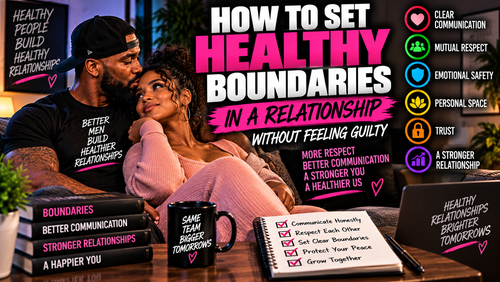
2. Your Boundaries Are Respected
Healthy love does not mean unlimited access to another human being.
You are still an individual.
And individuals need boundaries.
Healthy boundaries might involve:
Personal space.
Friends.
Family.
Money.
Phones.
Social media.
Physical affection.
Sex.
Work.
Communication.
Privacy.
Time alone.
You should be able to communicate:
"I'm not comfortable with that."
without automatically being punished, mocked, threatened, manipulated, or guilted.
Your partner can ask questions.
You can discuss boundaries.
Sometimes compromises are appropriate.
But repeatedly ignoring clearly communicated boundaries is not a sign of love.
Respecting someone's "no" is part of respecting the person.
3. You Feel Safe Communicating Honestly
This may be one of the most important healthy relationship habits.
Can you talk?
Not just about movies, work, food, and what happened on TikTok.
Can you talk about the difficult stuff?
Money.
Sex.
Jealousy.
Parenting.
Family.
Insecurities.
Expectations.
Future plans.
Things your partner does that bother you.
Things you've done wrong.
You shouldn't have to rehearse every serious conversation because you're terrified of how your partner will react.
Healthy communication sounds more like:
"This is bothering me. Can we talk about it?"
And the response isn't automatically:
"Oh, here we go again!"
Instead, both people try to understand what's happening.
That doesn't guarantee the conversation will be comfortable.
Some conversations aren't.
But emotional safety means honesty doesn't automatically become warfare.
4. You Listen to Understand, Not Just to Respond
Talking isn't the same as communicating.
You can have two people yelling paragraphs at each other and technically they're both "talking."
Nobody's listening.
Real communication requires something harder:
Trying to understand another person's experience even when you disagree with their conclusion.
Your partner says:
"When you did that, I felt ignored."
The instinctive response might be:
"I DIDN'T IGNORE YOU!"
But now you're arguing about intent instead of understanding impact.
Try:
"That wasn't my intention. Tell me what made you feel ignored."
Completely different conversation.
Listening doesn't automatically mean agreeing.
It means you're gathering information before preparing your defense.
That's a skill.
And strong couples practice it.
5. Support Isn't Conditional
It's easy to support somebody when they're winning.
Promotion?
Let's celebrate.
Business doing great?
Let's celebrate.
Weight loss?
Let's celebrate.
Graduation?
Let's celebrate.
But life isn't permanently in celebration mode.
There will be losses.
Bad days.
Failures.
Job problems.
Family problems.
Financial stress.
Confidence issues.
Plans that don't work.
Sometimes your partner doesn't need a motivational speech.
They need:
"I'm here."
Healthy support doesn't mean enabling destructive behavior or agreeing with every decision.
Sometimes support includes telling somebody something they don't want to hear.
But the underlying message remains:
We're going to figure this out.
That's partnership.
6. Conflict Doesn't Destroy the Relationship
Let's kill a relationship myth.
Healthy couples argue.
Of course they do.
You're combining two different human beings.
Different childhoods.
Different habits.
Different personalities.
Different expectations.
Different communication styles.
Different opinions.
Eventually somebody is going to say:
"Why the hell do you keep leaving the cabinet door open?" 😂
Conflict itself isn't necessarily the problem.
How you handle conflict matters more.
Healthy conflict avoids things such as:
Personal attacks.
Humiliation.
Threats.
Violence.
Intimidation.
Constantly threatening to leave.
Weaponizing private information.
Bringing up every mistake somebody has made since 2009.
The mission should eventually become:
Us vs. the problem.
Not:
Me vs. you.
7. You Can Apologize Without Adding "But"
This one can save relationships.
A lot of apologies aren't really apologies.
"I'm sorry, BUT you made me mad."
"I'm sorry, BUT you did it first."
"I'm sorry you feel that way."
Nah. 😂
Sometimes the sentence simply needs to be:
"I was wrong. I'm sorry."
That's difficult because the ego hates losing.
But relationships aren't courtrooms.
You don't receive a trophy for winning every argument.
Taking responsibility builds trust.
And both people need to be capable of it.
If one person is always apologizing while the other person is somehow never wrong?
That's a problem.
8. Trust Is Protected
Trust in relationships goes far beyond infidelity.
Trust means:
I believe your word.
I can rely on you.
I can tell you something vulnerable.
I believe you'll protect private information.
I trust you with shared responsibilities.
I trust that your behavior roughly matches what you tell me.
Trust is built through small things.
Showing up.
Keeping promises.
Being truthful.
Doing what you said you'd do.
Admitting mistakes.
Being consistent.
And here's the part people forget:
Trust requires maintenance.
You don't earn somebody's trust once and own it forever.
You continue behaving in ways worthy of it.
9. Appreciation Is Expressed
Long-term relationships can become dangerously familiar.
At the beginning:
"Thank you so much!"
Ten years later:
Dinner magically appears.
Laundry magically gets done.
Bills magically get handled.
Kids magically get everywhere.
The house magically keeps functioning.
😂
Except nothing is magic.
Somebody is doing the work.
Notice it.
Say:
"Thank you."
Say:
"I appreciate you."
Compliment your partner.
Send the random text.
Bring them their favorite snack.
Make their coffee.
Take something off their plate when they're overwhelmed.
Tell them you're proud of them.
Small gestures matter because relationships are mostly made of ordinary days.
You don't need Valentine's Day to show appreciation.
Tuesday works.
Healthy Relationships Still Have Bad Days
This is important.
If you read a list of healthy relationship signs, it's easy to think:
"We argued yesterday. Maybe our relationship isn't healthy."
Not necessarily.
Healthy doesn't mean perfect.
You're going to misunderstand each other.
Get irritated.
Say something poorly.
Have stressful weeks.
Be tired.
Get distracted.
Make mistakes.
Sometimes one person may be doing better than the other.
The question is:
Can you repair?
Can you calm down?
Talk?
Apologize?
Understand what happened?
Make adjustments?
Move forward?
Repair is one of the most underrated relationship skills.
You Should Grow Together
A strong relationship shouldn't require you to remain frozen in time.
You're supposed to change.
The person you were at 25 shouldn't necessarily be identical to the person you are at 45.
Your interests may change.
Career may change.
Goals may change.
Body may change.
Priorities may change.
Mindset may change.
A healthy partner doesn't respond to every attempt at personal growth with:
"Why are you acting different?"
Sometimes different is exactly the mission.
You should be able to encourage each other:
Get healthier.
Become financially stronger.
Build confidence.
Learn.
Create.
Travel.
Try new things.
Pursue goals.
Love shouldn't require shrinking yourself so your partner remains comfortable.
Ideally, you inspire each other to Become More.
But Growth Isn't Control
There's an important difference.
Encouragement:
"I know you've been wanting to get healthier. Want to walk together tonight?"
Control:
"You need to lose weight because I don't like how you look."
Encouragement:
"Let's build a better financial plan together."
Control:
"You aren't allowed to spend any money without asking me."
One supports growth.
The other attempts to dominate.
Healthy relationships involve partnership.
Not ownership.
Don't Lose Yourself Inside the Relationship
Love somebody.
Build together.
Create shared goals.
But keep developing as an individual too.
Maintain appropriate friendships.
Have hobbies.
Take care of your health.
Learn.
Develop skills.
Spend some time alone.
Have personal goals.
Your partner shouldn't have to become your:
Only friend.
Only hobby.
Only emotional outlet.
Only source of happiness.
Only identity.
You're building a life together.
That requires two people who still have identities of their own.
Love Is More Than a Feeling
Early relationships are heavily powered by emotion.
Everything is exciting.
You want to talk constantly.
See each other constantly.
Touch each other constantly.
Then real life enters the chat. 😂
Jobs.
Bills.
Kids.
Laundry.
Stress.
Responsibilities.
Routine.
Long-term love eventually requires more than butterflies.
It requires intentional behavior.
Sometimes love looks like romance.
Sometimes it looks like:
Doing dishes because your partner is exhausted.
Taking the kids so they can rest.
Having a difficult conversation instead of avoiding it.
Keeping your word.
Apologizing.
Choosing patience.
Making time.
Listening.
Love isn't only something you feel.
It's something you repeatedly do.
The EBM Relationship Check-In
Here's something practical you can use.
Once a week or once a month, sit down together without distractions.
Put the phones away.
Ask five questions:
1. How are you doing—really?
Not:
"You good?"
"Yeah."
Conversation over.
Actually ask.
2. Is there anything we've been avoiding talking about?
Small problems become big problems when ignored long enough.
3. What have I done lately that made you feel appreciated?
Now you know what works.
4. Is there anything you need more—or less—of from me?
Listen carefully.
5. What are we building together?
Vacation?
Savings?
Home?
Family goal?
Fitness?
Business?
Retirement?
Relationship?
Give yourselves something to move toward together.
The 30-Day EBM Relationship Challenge
Want to strengthen your relationship?
For 30 days:
WEEK 1 — COMMUNICATION
Spend at least 15 distraction-free minutes talking every day.
WEEK 2 — APPRECIATION
Express one specific thing you appreciate about your partner each day.
WEEK 3 — CONNECTION
Do something together without phones or outside distractions.
WEEK 4 — GROWTH
Choose one shared goal and create a plan for achieving it.
Nothing fancy.
No $5,000 vacation required.
We're strengthening the habits underneath the relationship.
When a Relationship Isn't Healthy
Personal growth content shouldn't pretend every relationship can—or should—be saved.
Some problems go beyond ordinary communication struggles.
Repeated intimidation, coercive control, threats, violence, stalking, or other abuse are not simply "relationship communication problems."
If you're dealing with something like that, prioritize safety and consider seeking appropriate professional or local support.
"Fight for your relationship" isn't universal advice.
Sometimes becoming more means recognizing when something is harming you.
Relationships Are Part of Self-Improvement
This is why Relationships belongs beside Health, Wealth, Fitness, and Mindset inside EBM.
Because what good is becoming more successful if you're destroying everybody around you?
What good is money if your relationships are chaos?
What good is discipline if you can't communicate?
What good is personal growth if the people closest to you never experience the better version of you?
Real growth should eventually show up in:
How you listen.
How you apologize.
How you communicate.
How you love.
How you respect boundaries.
How you handle disagreements.
How you show appreciation.
How you keep your word.
That's growth too.
Healthy Love Is Intentional
A strong relationship isn't two perfect people magically finding each other.
It's two imperfect people repeatedly choosing behaviors that protect what they're building.
Be honest.
Communicate.
Respect boundaries.
Protect trust.
Show appreciation.
Support each other's growth.
Learn how to disagree without becoming enemies.
And never become so comfortable that you stop choosing the person beside you.
Because healthy relationships aren't built once.
They're built daily.
Keep growing individually.
Keep growing together.
Keep choosing each other.
And EvolvE together.
EvolvE Become More
Helping You Become More Every Day.