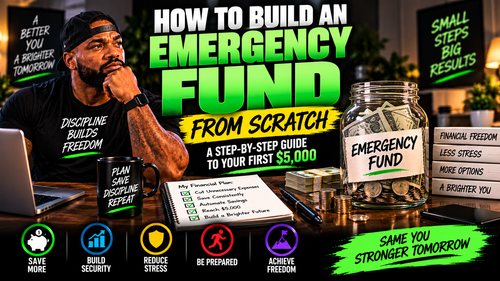
How to Build an Emergency Fund From $0: A Step-by-Step Guide to Your First $5,000
Your tire blows.
$287.
The refrigerator quits.
$800.
Your kid needs something unexpectedly.
$200.
You miss work.
Your hours get cut.
The deductible hits.
The dog needs the vet.
Life has a funny way of sending bills that somehow never checked your budget first. 😂
And when you have zero emergency savings, every unexpected expense feels like a crisis.
So what happens?
Credit card.
Payday loan.
Borrow from family.
Buy now, pay later.
Overdraft.
Skip another bill.
Then one $500 emergency creates months of financial problems.
That's why one of the first major goals on your journey toward financial freedom should be building an emergency fund.
Not because emergency savings will make you rich.
Because they can stop life's ordinary problems from constantly making you poorer.
If you're wondering how to build an emergency fund from $0, we're going to make this ridiculously simple.
No millionaire math.
No unrealistic:
"Just save $2,000 every month!"
We're starting exactly where millions of people actually start.
Zero.
And we're building from there.
What Is an Emergency Fund?
An emergency fund is money you've intentionally set aside for unexpected, necessary expenses.
Think:
Car repairs.
Home repairs.
Medical expenses.
Unexpected travel.
Loss of income.
Insurance deductibles.
Urgent family expenses.
Necessary appliance replacement.
The key words are:
Unexpected + Necessary.
Christmas isn't an emergency.
You knew December was coming. 😂
Vacation isn't an emergency.
New Jordans aren't an emergency.
A PS5 isn't an emergency.
Black Friday isn't an emergency.
Those are things you can create separate savings funds for.
Your emergency fund has one job:
Protect you when life goes sideways.
Why Do You Need an Emergency Fund?
Without savings, you're financially fragile.
Imagine two people both receive a $700 car repair.
Person A has $3,000 in emergency savings.
They hate spending $700.
But they pay it.
Problem handled.
Person B has $14 until payday.
Now they may have to borrow the $700.
And depending on how they borrow it, the repair may eventually cost much more because of interest or fees.
Same emergency.
Completely different financial impact.
That's what savings buys you.
Not excitement.
Options.
And options are a form of financial freedom.
How Much Should You Have in an Emergency Fund?
You'll hear a common recommendation:
3–6 months of essential living expenses.
That's a useful long-term target for many households, but your ideal amount depends on your circumstances.
Someone with:
Stable employment.
Two household incomes.
Low expenses.
Strong insurance.
may need a different cushion than someone with:
Variable income.
One income.
Children.
An older home.
An unreliable vehicle.
High medical costs.
Self-employment.
Instead of becoming overwhelmed by the final number, we're going to build your emergency savings in stages.
The EBM Emergency Fund Ladder
Here's our system:
LEVEL 1 — $500
Stop the small emergencies.
LEVEL 2 — $1,000
Create breathing room.
LEVEL 3 — One Month of Essential Expenses
Build stability.
LEVEL 4 — $5,000
Build serious protection.
LEVEL 5 — 3–6 Months of Essential Expenses
Build financial resilience.
Don't worry about Level 5 yet.
Beat Level 1.
Then Level 2.
We're turning financial security into a game with checkpoints.
LEVEL 1: Save Your First $500
If you're starting with no savings, $500 is your first mission.
Why $500?
Because $500 can handle or soften many smaller emergencies.
A tire.
Minor repair.
Deductible.
Unexpected bill.
Medication.
Home repair.
It may not completely solve every problem, but it's significantly better than $0.
Your first goal:
$500.
Not $10,000.
Not six months of expenses.
Five hundred dollars.
Let's get that win.
How to Save $500 Quickly
Don't rely only on cutting expenses.
Attack this from both directions:
Spend Less + Earn More
Look around your house.
Anything you don't use?
Sell it.
Old electronics.
Furniture.
Clothes.
Tools.
Collectibles.
Gaming equipment.
Then look at your income.
Can you:
Work overtime?
Pick up a shift?
Deliver food or groceries?
Freelance?
Do yard work?
Clean houses?
Detail cars?
Sell a skill?
Take weekend work?
The first $500 doesn't have to come from your regular paycheck alone.
Create the money.
The $20 Emergency Fund Trick
Here's an easy mental game.
Instead of saying:
"I need $500."
Think:
25 twenty-dollar bills.
That's it.
$20 × 25 = $500.
Save one $20?
You're 4% there.
Save five?
$100.
Now the goal doesn't feel enormous.
That's one of the best ways to make financial goals psychologically easier.
Break big numbers into small wins.
LEVEL 2: Build Your First $1,000
Once you hit $500:
Don't stop.
Now we're going for:
$1,000.
This is a powerful psychological milestone.
For somebody who's lived paycheck to paycheck for years, seeing four figures sitting untouched in savings feels different.
Your brain starts realizing:
"Wait...we actually have money."
And that's where the danger enters. 😂
Because suddenly you'll remember 87 things you could buy.
Don't.
That $1,000 has a job.
Its job is protection.
Keep Your Emergency Fund Separate
Don't keep emergency savings mixed with everyday spending money if that makes it too easy to spend.
You see:
Checking: $400
Savings: $1,200
Your brain says:
"Technically...I got $1,600."
No.
😂
You have $400.
The emergency fund belongs to Future You.
Consider keeping it in a separate savings account where the money is still accessible when genuinely needed but isn't constantly staring at you beside your spending balance.
For some people, a high-yield savings account may be appropriate because it can earn interest while remaining relatively accessible.
Compare account terms, fees, withdrawal access, insurance coverage, and current rates before choosing one.
Automate Your Savings
This is where saving becomes powerful.
Don't make yourself decide every payday:
"Should I save this time?"
Remove the decision.
Automatically transfer:
$25.
$50.
$100.
$200.
Whatever fits your budget.
If you get paid every two weeks and automatically save $100 each paycheck:
That's approximately:
$2,600 per year
before considering interest.
Not because you made some heroic financial move.
Because the system kept repeating.
Automation turns saving from an intention into infrastructure.
Pay Yourself First
Most people save backward.
They do:
Income → Bills → Spending → Fun → Save Whatever Is Left
Guess what's usually left?
😂
Exactly.
Try:
Income → Savings → Bills → Planned Spending
This is called paying yourself first.
Now, obviously, required bills and necessities still have to be covered.
But the principle is that savings becomes a planned category instead of an afterthought.
Even if you start tiny.
$10 matters.
Because you're establishing the behavior:
I keep some of what I earn.
That's a wealth-building identity.
LEVEL 3: Save One Month of Essential Expenses
Now things get serious.
Let's say your essential monthly expenses are:
Mortgage/Rent: $1,200
Utilities: $300
Groceries: $500
Transportation: $500
Insurance: $300
Minimum debt payments: $300
Other essentials: $400
Total:
$3,500 per month
Your next target would be roughly:
$3,500
Now imagine losing income unexpectedly.
Instead of immediate panic, you've bought yourself approximately one month of essential-expense coverage.
That's not financial independence.
But it's breathing room.
And breathing room can help you make better decisions.
Know Your "Survival Number"
This is important.
Your emergency-fund calculation doesn't necessarily need to include every dollar you normally spend.
If income disappeared tomorrow, you probably wouldn't continue spending exactly the same way.
Your survival budget might eliminate:
Entertainment.
Restaurants.
Shopping.
Vacations.
Nonessential subscriptions.
Other optional expenses.
Calculate what it actually costs to keep your household functioning.
Ask:
"What does one month of survival cost?"
That's a number every adult should know.
LEVEL 4: Build Toward $5,000
Now we're entering real financial-defense territory.
A $5,000 emergency fund can potentially absorb larger setbacks without immediately forcing you into debt.
Depending on your expenses, it could cover:
Major car repairs.
A home repair.
Insurance deductibles.
Temporary income disruption.
Unexpected travel.
Multiple smaller emergencies close together.
And trust me:
Emergencies love bringing friends.
😂
The car breaks.
Then the dryer quits.
Then something starts leaking.
All in the same week.
That's when a larger cash buffer becomes powerful.
How Long Does It Take to Save $5,000?
Let's look at the math.
If you save:
$50/week
$5,000 takes about 100 weeks.
At:
$100/week
About 50 weeks.
At:
$200/week
About 25 weeks.
At:
$500/month
About 10 months.
At:
$1,000/month
About 5 months.
That's before interest and assumes you don't need to use part of the fund along the way.
The lesson?
Your savings rate matters enormously.
Which means if cutting expenses isn't enough, we need another lever.
Increase Your Income
There comes a point where you can't cut much more.
You can cancel Netflix.
Switch insurance.
Stop eating out.
Reduce subscriptions.
But your electric company isn't going to accept:
"I'm on my financial freedom journey, bro."
😂
You still have expenses.
That's when increasing income becomes crucial.
Try to create an Emergency Fund Accelerator.
Maybe:
Overtime.
Weekend work.
Gig work.
Freelancing.
Selling products.
Selling digital products.
Online business.
Local service work.
Part-time job.
Whatever fits your situation.
Then create a rule:
All accelerator income goes toward the current financial mission.
Now your regular income maintains life.
Your extra income builds freedom.
That's powerful.
The Side-Hustle Trap
There's one catch.
You make an extra $600.
Then immediately think:
"Man, I worked hard. I deserve something."
Suddenly:
New shoes.
Restaurant.
Amazon.
Random stuff.
$600 becomes $83.
😂
You did the extra work but never captured the financial benefit.
Decide what happens to side-hustle money before you earn it.
Maybe:
80% → Emergency Fund
20% → Enjoy
Or:
100% → Emergency Fund until you reach $1,000.
Your percentages can vary.
The point is having a rule.
Cut Expenses Without Making Yourself Miserable
Saving money doesn't mean eliminating everything enjoyable.
Start with things you don't care much about.
Unused subscriptions.
Expensive insurance that can be responsibly replaced with better-value coverage.
Bank fees.
Food waste.
Delivery fees.
Impulse purchases.
Duplicate services.
Unused memberships.
Then optimize bigger expenses where possible.
Housing.
Transportation.
Insurance.
Debt interest.
Food.
Those categories often matter much more than arguing with yourself over a $3 coffee.
Cut ruthlessly where you don't care.
Spend intentionally where you do.
Use Windfalls to Jump Levels
Tax refund?
Emergency fund.
Bonus?
Emergency fund.
Overtime?
Emergency fund.
Sold something?
Emergency fund.
Unexpected money?
Emergency fund.
You don't have to put every dollar toward savings forever.
But while you're building your initial financial foundation, windfalls can accelerate the process dramatically.
Imagine you're sitting at:
$1,700
Then receive a $1,200 refund.
Instead of spending it?
Now you're at:
$2,900.
You just skipped months of progress.
Use financial opportunities strategically.
What Counts as an Emergency?
Before using the money, ask three questions:
1. Is it unexpected?
2. Is it necessary?
3. Does it need to be handled now?
If the answer to all three is yes?
Probably a legitimate emergency-fund expense.
Car repair needed to get to work?
Yes.
New 75-inch television because it's 40% off?
My guy.
😂
No.
What Happens If You Use Your Emergency Fund?
You saved $2,000.
Then the transmission needs repair.
You spend $1,300.
Now you're back at $700.
Did you fail?
NO.
The emergency fund did exactly what it was supposed to do.
Without it, you might have added $1,300 to a credit card.
That's a victory.
Now your next mission becomes:
Rebuild the fund.
Emergency savings aren't trophies.
They're tools.
Sometimes tools get used.
Should You Save or Pay Off Debt First?
This is where personal finance becomes more nuanced.
If you have high-interest debt, throwing every available dollar into savings while expensive interest compounds may not be optimal.
But having zero cash buffer can also be risky because the next emergency may simply send you deeper into debt.
A common strategy is:
Build a starter emergency fund.
Then:
Attack high-interest debt aggressively.
Then:
Expand your emergency fund.
The right order depends on your debt rates, income stability, expenses, access to credit, household needs, and risk tolerance.
The key is not treating debt payoff and emergency savings as completely unrelated goals.
They protect each other.
Emergency Fund vs. Sinking Fund
These aren't the same thing.
An emergency fund covers unexpected expenses.
A sinking fund saves for expected future expenses.
For example:
Christmas.
Car tires.
Vacation.
Property taxes.
Annual insurance.
Back-to-school shopping.
Home maintenance.
Car maintenance.
If you know something is coming, start saving before it arrives.
This protects your emergency fund from expenses that weren't actually emergencies.
The EBM $5,000 Emergency Fund Challenge
Let's turn this into a mission.
PHASE 1 — $0 → $500
Goal: Stop small emergencies from becoming debt.
Go hard.
Sell things.
Cut unnecessary expenses.
Work extra.
Get there.
PHASE 2 — $500 → $1,000
Goal: Build breathing room.
Automate your savings.
Capture extra income.
Protect the money.
PHASE 3 — $1,000 → $2,500
Goal: Build stability.
Now saving becomes part of your lifestyle.
Keep going.
PHASE 4 — $2,500 → $5,000
Goal: Build your financial shield.
This stage may take longer.
That's fine.
Keep stacking.
Make Saving Visual
This works ridiculously well.
Create a tracker with:
100 boxes × $50 = $5,000
Every time you save $50:
Color in a box.
Now you're not chasing some abstract number.
You're watching progress happen.
25 boxes?
$1,250.
50 boxes?
$2,500.
75 boxes?
$3,750.
100 boxes?
$5,000.
Mission complete.
Then build the next level.
Why Saving Money Feels Slow at First
The beginning is the hardest.
Going from:
$0 → $100
doesn't feel life-changing.
Neither does:
$100 → $250.
But then:
$500.
$1,000.
$2,000.
$3,000.
Something changes psychologically.
You start becoming protective of the number.
You stop thinking:
"What can I buy?"
and start thinking:
"How high can I get this?"
That's when saving starts becoming addictive in a good way.
You're watching your financial strength increase.
The Real Goal Isn't $5,000
This is important.
The $5,000 is a milestone.
The real goal is becoming a person who:
Doesn't spend everything they earn.
A person who:
Plans.
Saves.
Prepares.
Builds.
Protects.
Thinks ahead.
Because once you learn how to save $5,000...
you've developed the system that can eventually help you save:
$10,000.
$25,000.
$50,000.
And beyond.
The number changes.
The skill remains.
From Emergency Fund to Wealth Building
Eventually, your emergency savings reaches an appropriate target.
Then what?
Now the money you were aggressively saving can be redirected toward bigger goals.
Debt elimination.
Retirement.
Investments.
Homeownership.
Mortgage payoff.
Business.
Education.
Real estate.
Other productive assets.
Your emergency fund becomes the foundation underneath your wealth-building strategy.
Think of it like building a house.
Investments may be the upper floors.
Your emergency fund?
That's part of the foundation.
Nobody flexes the foundation.
But without it, the whole structure is more vulnerable.
The EBM Financial Order
Here's a simple framework:
1. CONTROL YOUR CASH FLOW
Know what's coming in and going out.
2. BUILD STARTER SAVINGS
Get that first cash buffer.
3. ATTACK DESTRUCTIVE DEBT
Stop expensive interest from eating your future.
4. BUILD A FULL EMERGENCY FUND
Create real protection.
5. BUILD ASSETS
Invest and grow your wealth appropriately.
6. BUY FREEDOM
Reduce dependence on debt and eventually on mandatory labor.
That's the journey.
Not:
Get rich quick.
But:
Get strong slowly.
Your First $500 Changes More Than Your Bank Account
It changes how you think.
For perhaps the first time, an unexpected bill arrives and instead of:
"OH NO."
you think:
"Annoying...but I got it."
That's a different life.
Not rich.
Not financially independent.
But stronger.
Then $500 becomes $1,000.
$1,000 becomes $2,500.
$2,500 becomes $5,000.
Then eventually you look at a problem that once would've destroyed your entire month and realize:
It's just an expense now.
That's what financial security starts feeling like.
Start With the First $20
Don't leave this article thinking:
"Yeah, I really need to save $5,000 someday."
That's exactly how nothing happens.
Open the savings account.
Transfer:
$20.
That's it.
Now you're no longer trying to build an emergency fund.
You're building one.
Huge psychological difference.
Then find another $20.
And another.
Keep stacking.
Because financial freedom doesn't begin when you become wealthy.
It begins when you stop spending every dollar the moment it touches your hands.
Build the $500.
Then $1,000.
Then one month.
Then $5,000.
Then keep going.
One dollar.
One paycheck.
One side hustle.
One disciplined decision at a time.
You don't need to get rich tomorrow.
You need to become harder to financially knock down.
Build the cushion.
Protect your household.
Create options.
Then use that stability to build wealth.
That's how you EvolvE.
EvolvE Become More
Helping You Become More Every Day.