How to Stay Poor: 7 Habits Keeping You Broke, Stuck, and Unsuccessful

Everybody wants more money.
Fewer people are willing to examine the habits keeping them poor.
That's an uncomfortable conversation because it's easier to blame your job, the economy, your upbringing, your bills, or somebody else's success.
And to be clear: not everyone struggling financially is struggling because of bad habits. Wages, emergencies, housing costs, debt, health expenses, family responsibilities, and plain bad luck are real.
But there's another truth:
Some things are outside your control.
Your daily decisions aren't.
You might not be able to change your income today.
But you can change what you do after work.
You can change what you learn.
You can change what you spend.
You can change what you build.
You can change what you do with the next 365 days.
If you want to stop being broke and start building wealth, these are seven habits worth eliminating.
1. Watching Your Life Away
Entertainment isn't the enemy.
But unlimited entertainment can absolutely become one of the habits keeping you stuck.
Think about it.
You work all day.
Come home.
Sit down.
Turn on Netflix, YouTube, TikTok, gaming, social media, or whatever your favorite escape happens to be.
Suddenly it's bedtime.
Repeat tomorrow.
Repeat Friday.
Repeat next week.
Repeat for five years.
There's nothing wrong with watching TV or enjoying yourself.
The problem starts when you're giving entertainment your best remaining hours every single day while telling yourself you don't have enough time to improve your life.
Imagine reclaiming just one hour per day.
That's 365 hours per year.
You could use that time to learn a marketable skill, build a side hustle, exercise, work on your business, study personal finance, create content, or earn additional income.
You don't necessarily need more time.
Sometimes you need to take your time back.
2. Having No Hobbies That Build You
A hobby doesn't have to make money.
That's important.
Some hobbies should exist simply because they make life enjoyable.
But if everything you do outside work involves passive consumption, you're missing an opportunity.
Develop hobbies that create something.
Cooking.
Woodworking.
Photography.
Music production.
Writing.
Fitness.
Gardening.
Coding.
Graphic design.
Content creation.
Repairing things.
Learning another language.
You don't know where those interests might eventually lead.
A hobby can become a skill.
A skill can become expertise.
Expertise can become income.
And income can become assets.
That's one of the overlooked paths to building wealth from scratch.
3. Living Without a Bigger Mission
There's a difference between existing and building.
Wake up.
Work.
Come home.
Eat.
Scroll.
Sleep.
Repeat.
That cycle can become dangerously comfortable.
You need something you're moving toward.
Maybe that's:
Paying off your house.
Building a $10,000 emergency fund.
Losing 50 pounds.
Starting a business.
Becoming debt-free.
Learning a trade.
Buying your first investment.
Building something for your family.
Your goal doesn't need to impress anybody.
It simply needs to give your effort direction.
When you know what you're building, saying no becomes easier.
You aren't randomly saving money.
You're buying freedom.
You aren't randomly working after hours.
You're building another income stream.
You aren't randomly studying.
You're increasing your value.
Purpose changes the meaning of sacrifice.
4. Staying in Your Comfort Zone
Your comfort zone has a sneaky sales pitch:
"Just stay here. You're safe."
And that's true.
It's comfortable.
But comfortable and successful aren't always headed in the same direction.
Getting healthier is uncomfortable.
Budgeting can be uncomfortable.
Starting a business is uncomfortable.
Learning something when you initially suck at it is uncomfortable.
Applying for a better job is uncomfortable.
Making your first sales call is uncomfortable.
Going back to school at 40 is uncomfortable.
Admitting you've been handling money wrong is uncomfortable.
But here's the question:
What if the life you want is sitting right outside the life you're comfortable living?
You don't have to become reckless.
Take calculated risks.
Move intelligently.
But move.
5. Waiting for Magic
This one will keep somebody stuck forever.
Waiting for the perfect business idea.
Waiting to feel motivated.
Waiting for your tax refund.
Waiting until January.
Waiting for somebody to discover you.
Waiting until you have more money.
Waiting until life slows down.
Waiting until you're ready.
Here's the bad news:
Ready might never show up.
You become ready by doing.
Your first attempt probably won't be perfect.
Good.
Make attempt number two.
Then number three.
People often look at successful people and see the finished product.
They don't see the failed ideas, embarrassing beginnings, late nights, bad decisions, tiny audiences, rejected applications, unsuccessful launches, and years of improvement.
There's usually no magic.
There's repetition.
6. Blaming Everybody Else
This one is dangerous because sometimes the blame is legitimate.
Somebody really did you wrong.
Your employer might really underpay you.
You might really have been dealt a bad hand.
The economy really might suck.
You may genuinely have disadvantages somebody else doesn't.
But here's the problem:
Being correct about who's responsible doesn't automatically improve your situation.
At some point the question has to change from:
"Whose fault is this?"
to:
"What can I do next?"
That's not letting anybody off the hook.
That's refusing to give them control over the rest of your life.
Ownership is powerful because ownership creates options.
7. Spending Everything You Make
This is one of the biggest bad money habits to attack.
You make $3,000.
You spend $3,000.
You get a raise and make $4,000.
Now somehow you spend $4,000.
You start making $5,000.
Suddenly you've developed a $5,000 lifestyle.
That's lifestyle inflation.
And it can keep someone with a decent salary living paycheck to paycheck for decades.
The solution isn't necessarily becoming ridiculously cheap.
It's giving your money jobs.
Money for bills.
Money for emergencies.
Money for debt.
Money for investing.
Money for enjoyment.
Money for your goals.
The objective is simple:
Create a gap between what you earn and what you spend.
Then use that gap strategically.
That's where financial progress begins.
Being Broke and Being Poor Aren't the Same Thing
This distinction matters.
Broke can be temporary.
You can have a rough month.
Lose a job.
Get hit with an emergency.
Have unexpected expenses.
That doesn't define you.
The bigger danger is developing behaviors that repeatedly recreate the same financial situation.
If every raise disappears...
Every tax refund disappears...
Every bonus disappears...
Every extra dollar disappears...
Then increasing your income alone may not solve the problem.
You have to upgrade the system controlling the money.
The EBM Formula: Earn → Keep → Build
If you're trying to figure out how to improve your finances, simplify the mission.
EARN MORE
Increase your value.
Learn skills.
Negotiate.
Change positions when appropriate.
Build additional income streams.
Create something people will pay for.
KEEP MORE
Control lifestyle inflation.
Track spending.
Eliminate unnecessary recurring expenses.
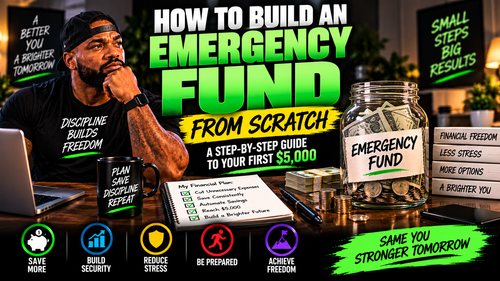
Build an emergency fund.
Attack high-interest debt.
BUILD MORE
Once your financial foundation is stable, begin turning income into things capable of growing your net worth over time.
Retirement accounts.
Diversified investments.
Businesses.
Real estate where appropriate.
Other productive assets.
Making money is only part of wealth building.
Keeping and deploying it matters too.
The 30-Day EBM "Stop Staying Stuck" Challenge
Forget changing your entire life this afternoon.
For the next 30 days, do five things:
1. Reclaim one hour.
Reduce low-value entertainment and redirect that time toward your goals.
2. Track every dollar.
You can't control money you refuse to look at.
3. Learn something valuable.
Spend at least 20 minutes per day developing your knowledge or skills.
4. Create before you consume.
Work on your body, business, career, home, finances, or craft before disappearing into entertainment.
5. Make one uncomfortable move every week.
Apply. Call. Create. Publish. Sell. Ask. Learn. Start.
After 30 days, you won't magically be rich.
That's not the promise.
You'll have something better:
Momentum.
Stop Asking for an Easier Life
There's nothing wrong with wanting comfort.
The problem is allowing comfort to become your highest priority.
Because the habits that feel good today can quietly create a future you don't want.
And the habits that feel difficult today can create choices later.
That's what financial discipline really buys you.
Choices.
The ability to handle an emergency.
The ability to leave a bad situation.
The ability to help somebody you love.
The ability to retire.
The ability to own your time.
So don't spend your life waiting for magic.
Turn off the noise.
Pick a mission.
Build a skill.
Control your money.
Take responsibility for what you can control.
And get moving.
You don't have to become wealthy tomorrow.
Just stop practicing the habits designed to keep you where you are.
That's how you EvolvE.
EvolvE Become More
Helping You Become More Every Day.