How to Stop Living Paycheck to Paycheck: 10 Changes to Make Now

You get paid Friday.
For about five minutes, everything feels good.
Then the bills hit.
Mortgage or rent.
Car payment.
Insurance.
Utilities.
Groceries.
Credit cards.
Gas.
Subscriptions.
By the time the next payday gets close, you're watching your bank account like it's the fourth quarter of the Super Bowl.
$87.42.
"Alright...just gotta make it till Friday."
Then Friday comes.
Money hits.
Bills hit.
And the cycle starts again.
If that sounds familiar, you're not alone.
But here's what matters:
Living paycheck to paycheck doesn't have to become your permanent lifestyle.
Breaking the cycle usually isn't one magical move.
It's a series of smaller financial decisions that gradually create something you've been missing:
Margin.
Money left over.
First $50.
Then $200.
Then $500.
Eventually thousands.
That gap between what you earn and what you spend is where financial freedom begins.
So if you're trying to figure out how to stop living paycheck to paycheck, here are 10 changes you can start making now.
1. Find Out Where Your Money Is Actually Going
Before you cut anything, save anything, or start another side hustle, we need the truth.
Pull up your last 30 days of transactions.
Bank account.
Credit cards.
Payment apps.
Everything.
Separate your spending into categories:
Housing
Transportation
Food
Utilities
Debt
Insurance
Subscriptions
Entertainment
Shopping
Other
Then total everything.
This exercise can be uncomfortable.
Good.
Because sometimes the problem isn't:
"I don't make enough money."
It's:
"I have no idea where $700 disappeared last month."
You can't control money you aren't tracking.
2. Calculate Your Financial Gap
Here's one number everybody trying to get ahead financially should know:
Monthly Income – Monthly Expenses = Financial Gap
Let's say your take-home income is:
$4,500
And your monthly expenses are:
$4,350
Your gap is:
$150
That's why you constantly feel broke.
There's almost no room for anything to go wrong.
Now suppose you reduce expenses by $300 and increase your income by $400.
Your new gap becomes:
$850 per month.
That's $10,200 over 12 months before accounting for taxes or other changes.
Same person.
Different system.
Your first wealth-building mission is simple:
Widen the gap.
3. Cut the Expenses You Barely Care About
Don't start by cutting everything you enjoy.
That's why extreme budgets often fail.
People create financial prison.
No restaurants.
No streaming.
No hobbies.
No coffee.
No fun.
Then three weeks later:
BOOM.
$400 spending spree because they're tired of being miserable.
Instead, start with expenses that provide little value.
Look for:
Subscriptions you forgot about.
Apps you don't use.
Memberships you don't need.
Expensive phone plans.
Insurance that hasn't been compared recently.
Delivery fees.
Unused software.
Automatic renewals.
Random convenience purchases.
You might find $100–$300 per month without dramatically changing your lifestyle.
That's potentially $1,200–$3,600 per year redirected toward your future.
4. Stop Letting Lifestyle Inflation Eat Your Raises
You get a raise.
Great.
Then something funny happens.
New car.
Better phone.
More eating out.
More subscriptions.
More shopping.
Bigger payments.
Six months later you're making more money...
and you're still broke.
That's lifestyle inflation.
As income rises, spending rises right alongside it.
If you want to stop living paycheck to paycheck, you have to break that connection.
When you get a raise, don't automatically spend all of it.
Take part of the increase and direct it toward:
Savings.
Debt.
Investing.
Your mortgage.
Your business.
Your long-term goals.
You can improve your lifestyle.
Just don't upgrade your lifestyle as fast as you upgrade your income.
That's how raises finally start changing your financial life.
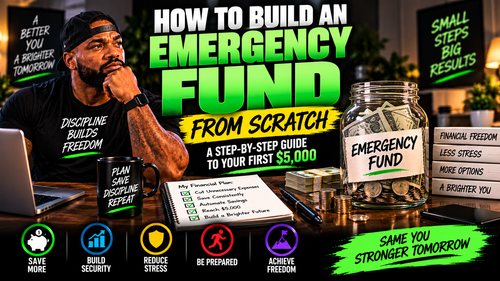
5. Build Your First $1,000 Emergency Fund
If you have no savings, every inconvenience becomes an emergency.
Flat tire?
Credit card.
Plumbing problem?
Credit card.
Car repair?
Credit card.
Unexpected medical bill?
Credit card.
Then you're paying for yesterday's emergency six months later—with interest.
That's why one of your first goals should be building a starter emergency fund.
Start with:
$500
Then:
$1,000
Eventually, work toward a larger emergency reserve appropriate for your household and financial situation.
The goal isn't to become wealthy from your emergency fund.
It's to create a financial shock absorber.
Life is going to throw punches.
Savings helps you absorb them without getting knocked all the way back to zero.
6. Attack High-Interest Debt
Debt doesn't just take your money.
It takes future money you haven't earned yet.
That's what makes consumer debt dangerous.
You get paid next month, but pieces of that paycheck already belong to:
Visa.
Mastercard.
Capital One.
Affirm.
Personal loans.
Car lenders.
Buy-now-pay-later accounts.
Whatever you've accumulated.
The more monthly payments you eliminate, the more of your paycheck comes back under your control.
Two popular strategies are:
Debt Snowball
Pay the smallest balance first while making minimum payments on everything else.
Once it's gone, roll that payment into the next debt.
This creates quick wins and momentum.
Debt Avalanche
Prioritize the debt with the highest interest rate.
This can reduce the amount of interest paid over time.
Either strategy can work.
Pick one.
Then attack.
Because every payment you eliminate creates more room in your monthly budget.
7. Create a Paycheck-to-Paycheck Budget
Monthly budgets are useful.
But if you're currently living paycheck to paycheck, budgeting each paycheck can be even more powerful.
Before payday arrives, tell the money where it's going.
For example:
PAYCHECK #1
Mortgage: $900
Utilities: $250
Groceries: $200
Gas: $100
Savings: $100
Debt: $150
Personal spending: $75
Now the money has instructions before it reaches your account.
Do the same with paycheck #2.
This reduces the classic:
"I got paid, so I have money."
illusion.
Your bank balance isn't necessarily your spending money.
Some of that money already has a mission.
8. Increase Your Income
This is where EBM takes a different approach from traditional personal finance.
We're not spending our entire lives trying to figure out how to save another $3.
Cutting expenses matters.
But there's a floor.
You can't reduce your rent below zero.
You can't eliminate food.
You need transportation.
You need utilities.
Eventually, the biggest lever becomes:
INCOME.
Ask yourself:
Can I work overtime temporarily?
Can I pick up weekend work?
Can I freelance?
Can I deliver food or groceries?
Can I sell something?
Can I learn a higher-paying skill?
Can I earn a certification?
Can I start a small online business?
Can I create digital products?
Can I negotiate my salary?
Can I apply for a better-paying position?
An extra $500 per month is:
$6,000 per year.
An extra $1,000 per month is:
$12,000 per year.
An extra $2,000?
$24,000 per year.
Income growth can completely change the speed of your financial plan.
9. Don't Let Side-Hustle Money Become Play Money
This is where people fumble the bag.
They make an extra $600 this month.
Then immediately think:
"I deserve something."
And there goes $600.
Nah.
Give extra income a specific mission before you earn it.
Maybe:
50% → Debt
30% → Emergency Fund
10% → Investing or long-term goals
10% → Fun
Your percentages can be different.
That's not the point.
The point is that additional income shouldn't mysteriously disappear just because it wasn't part of your normal paycheck.
If you're working extra hours, make those hours buy something meaningful.
Not necessarily stuff.
Maybe they're buying:
Freedom.
A paid-off credit card.
A paid-off car.
A paid-off house.
An emergency fund.
A business.
Investments.
Your future.
Now the hustle has a purpose.
10. Stop Measuring Wealth by What People Can See
This might be the biggest mindset shift.
We live in a culture where wealth is supposed to look like something.
Cars.
Clothes.
Jewelry.
Vacations.
Big houses.
Restaurants.
Phones.
But you can't see somebody's:
Emergency fund.
401(k).
IRA.
Mortgage balance.
Credit card debt.
Business equity.
Investment portfolio.
Net worth.
A person driving a 10-year-old Toyota might have $300,000 invested.
Somebody driving an $80,000 luxury SUV might have $742 in savings.
You don't know.
So stop playing the look rich game.
It's expensive.
Build wealth quietly.
Let other people compete over appearances.
You're competing for freedom.
The Paycheck-to-Paycheck Trap Isn't Always About Spending
This deserves to be said clearly.
Sometimes the numbers simply don't work.
Housing costs are high.
Food costs are high.
Insurance is high.
Transportation is expensive.
Childcare can be brutal.
And some people genuinely don't earn enough to cover reasonable basic expenses.
You cannot budget your way out of every income problem.
If you've already cut unnecessary spending and the numbers are still negative, your strategy needs to shift heavily toward:
Increasing income.
That's why financial advice that amounts to:
"Stop buying coffee."
can miss the bigger picture.
Saving $30 helps.
Increasing your income by $15,000 per year helps a whole lot more.
Do both where possible.
The EBM Paycheck-to-Paycheck Escape Plan
Let's simplify everything.
PHASE 1 — CONTROL
Track every dollar for 30 days.
Know exactly what your life costs.
PHASE 2 — CREATE MARGIN
Cut low-value expenses.
Create your first $100–$500 of monthly breathing room.
PHASE 3 — PROTECT
Build your starter emergency fund.
PHASE 4 — ELIMINATE
Attack expensive consumer debt.
Every eliminated payment increases cash flow.
PHASE 5 — INCREASE
Grow your income through career advancement, skills, side income, or business.
PHASE 6 — BUILD
Once your foundation is strong, begin consistently building long-term assets appropriate for your situation.
That's the progression:
Control → Margin → Protection → Elimination → Income → Wealth
Your First Goal Isn't $1 Million
People love talking about becoming millionaires.
Cool.
But if you're currently living paycheck to paycheck, forget the million for a minute.
Your first goal might be:
Finish the month with $100 left.
Then $500.
Then save $1,000.
Then eliminate a payment.
Then build one month's expenses.
Then increase your income.
Then invest.
Then build your net worth.
Small wins begin compounding.
Eventually you're no longer asking:
"Can I make it until payday?"
You're asking:
"What's the smartest thing I can do with this extra money?"
That's a completely different financial life.
The 30-Day EBM Money Reset
For the next 30 days:
Week 1: Track every dollar.
Week 2: Cancel, reduce, or renegotiate at least three expenses.
Week 3: Find one way to generate additional income.
Week 4: Transfer your first chunk of money toward your emergency fund or highest-priority financial goal.
Then repeat.
Don't expect one month to fix years of financial habits.
But one month can absolutely change your direction.
And direction matters.
Payday Should Eventually Stop Feeling Like Rescue Day
That's the real goal.
You don't want every paycheck arriving just in time to save you from the last one.
You want to get ahead.
One paycheck ahead.
Then one month.
Then several months.
Then debt starts disappearing.
Savings starts growing.
Assets start growing.
And eventually money stops being something you're constantly chasing.
It becomes something you're controlling.
That's financial progress.
That's financial discipline.
And ultimately, that's how you begin building financial freedom.
Don't try to change everything tonight.
Find the next move.
Execute it.
Then find the next one.
Stop surviving from paycheck to paycheck. Start building from paycheck to paycheck.
That's how you EvolvE.
EvolvE Become More
Helping You Become More Every Day.