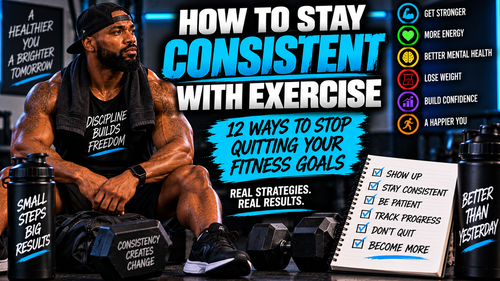
The Best Beginner Home Workout With No Equipment: Get Stronger From Home
You don't need a gym membership to start getting in shape.
You don't need a $2,000 home gym.
You don't need a Peloton, squat rack, fancy supplements, or matching workout outfit.
You need:
A little space.
Your body.
About 20–30 minutes.
And most importantly:
You need to start.
That's where a lot of people get stuck.
They spend weeks researching the "perfect workout."
Then they watch fitness videos.
Buy equipment.
Download apps.
Create playlists.
Order supplements.
And somehow...
Never actually work out. 😂
We're not doing that.
This beginner home workout with no equipment is designed for somebody who wants a simple starting point for building strength, improving fitness, and creating a workout habit without going to the gym.
No complicated exercises.
No two-hour sessions.
We're building the foundation first.
Can You Really Get Fit Working Out at Home?
Absolutely.
Your muscles don't know whether you're exercising inside a $100-per-month gym or beside your couch.
They respond to physical demand.
Bodyweight exercises can challenge your:
Chest.
Shoulders.
Triceps.
Legs.
Glutes.
Core.
And depending on the exercises available to you, parts of your back as well.
Eventually, equipment can make certain types of progression easier—especially pulling movements and heavier resistance training.
But if you're a beginner?
Your body is already resistance.
Use it.
Why Beginners Should Keep Workouts Simple
There's a temptation when starting fitness to do everything.
Monday: Chest.
Tuesday: Legs.
Wednesday: Back.
Thursday: Arms.
Friday: Abs.
Saturday: Cardio.
Sunday:
"Why does everything hurt?" 😂
You don't need an advanced bodybuilding split when you're just starting.
A beginner usually benefits from mastering basic movement patterns and gradually increasing training volume.
The goal during your first month isn't becoming shredded.
It's becoming someone who:
Works out consistently.
That's the foundation everything else gets built on.
The 7 Best Bodyweight Exercises for Beginners
Let's build your workout.
1. Bodyweight Squats
Targets: Legs + Glutes
Squats are one of the foundational lower-body movements.
Stand with your feet around shoulder width apart.
Brace your core.
Push your hips back and bend your knees.
Lower yourself as far as you can comfortably control.
Then stand back up.
Beginner Target:
2–3 sets × 8–15 reps
If regular squats are difficult, use a chair.
Sit down under control.
Stand back up.
That's a chair squat.
As you become stronger, gradually rely less on the chair.
2. Incline Push-Ups
Targets: Chest + Shoulders + Triceps
If you can't perform regular push-ups yet, don't worry about it.
Start elevated.
Use a sturdy countertop, bench, desk, or another stable surface.
Place your hands slightly wider than shoulder width.
Keep your body straight.
Lower your chest toward the surface.
Push yourself away.
Beginner Target:
2–3 sets × 6–12 reps
As you become stronger, lower the surface.
Wall → countertop → bench → low step → floor.
That's progression.
3. Glute Bridges
Targets: Glutes + Posterior Chain
Lie on your back.
Bend your knees.
Keep your feet flat on the floor.
Brace your core and squeeze your glutes as you raise your hips.
Pause briefly.
Lower yourself under control.
Beginner Target:
3 sets × 10–15 reps
Don't turn this into a lower-back contest.
The movement should primarily come from your hips.
4. Reverse Lunges
Targets: Legs + Glutes + Balance
Stand tall.
Step one foot backward.
Lower yourself under control.
Push through the front foot to return to standing.
Then switch sides.
Beginner Target:
2 sets × 6–10 reps per leg
If balance is difficult, lightly hold onto a sturdy chair or wall.
No shame.
We're training.
Not auditioning for the Olympics.
5. Push-Ups
Targets: Chest + Triceps + Shoulders + Core
Once incline push-ups become manageable, begin working toward floor push-ups.
Hands slightly wider than shoulder width.
Brace your core and glutes.
Keep your body relatively straight.
Lower yourself under control.
Push back up.
Beginner Target:
2–3 sets × 5–12 reps
Can't do five?
Do two.
Can't do one?
Go back to incline push-ups.
Your current ability isn't a failure.
It's simply the level you're training from.
6. Bird Dogs
Targets: Core + Stability
Start on your hands and knees.
Brace your core.
Extend one arm forward while extending the opposite leg backward.
Pause.
Return.
Switch sides.
Try to keep your hips relatively level instead of twisting.
Beginner Target:
2–3 sets × 6–10 reps per side
Move slowly.
This isn't supposed to look like you're swimming on the floor. 😂
Control matters.
7. Plank
Targets: Core
Place your forearms on the floor.
Extend your legs.
Brace your abs and glutes.
Keep your body relatively straight.
Hold.
Beginner Target:
10–30 seconds
Rest.
Repeat.
If a full plank is too difficult, use an elevated surface or modified position.
Your first goal isn't holding a plank for five minutes.
It's learning to maintain tension with good form.
The EBM Beginner Home Workout
Now let's put everything together.
WORKOUT A
Bodyweight Squats — 3 × 10
Incline Push-Ups — 3 × 8
Glute Bridges — 3 × 12
Bird Dogs — 2 × 8 each side
Plank — 2 × 20 seconds
WORKOUT B
Chair Squats or Bodyweight Squats — 3 × 12
Reverse Lunges — 2 × 8 each leg
Push-Ups or Incline Push-Ups — 3 × 6–10
Glute Bridges — 3 × 15
Plank — 2 × 20–30 seconds
That's it.
You don't need 37 exercises.
You need to get stronger at a few useful ones.
Your Beginner Weekly Workout Schedule
Start with three strength workouts per week.
For example:
MONDAY
Workout A
TUESDAY
Walk or recovery
WEDNESDAY
Workout B
THURSDAY
Walk or recovery
FRIDAY
Workout A
SATURDAY
Walk, recreational activity, or recovery
SUNDAY
Rest
The following week:
B → A → B.
This gives your muscles recovery time between strength sessions.
And it keeps the program simple enough to remember.
Add Walking to Your Home Fitness Plan
Strength training is only part of the equation.
Walking pairs beautifully with a home workout for beginners.
You don't need to start running.
Walk.
Start with:
10–20 minutes.
Then:
20–30 minutes.
Eventually:
30–45 minutes or more if appropriate for you.
You can also increase your everyday steps by:
Parking farther away.
Walking after meals.
Taking movement breaks.
Walking while talking on the phone.
Taking the stairs when appropriate.
Doing yard work.
Movement counts.
Your body doesn't require a treadmill to know you're walking.
How Long Should a Beginner Home Workout Take?
About 20–30 minutes can be plenty when you're starting.
That's another mistake beginners make.
They assume:
"If I don't exercise for an hour, it doesn't count."
Nah.
Twenty focused minutes performed consistently beats a 90-minute workout you do once every three weeks.
Start with something you can sustain.
Later, you can increase your training.
How Long Should You Rest Between Sets?
For most exercises in this beginner routine, roughly:
60–120 seconds
is reasonable.
But don't become obsessed with the stopwatch.
If you're still breathing heavily?
Rest longer.
The objective is to perform the next set with solid technique.
This isn't punishment.
It's training.
How to Make Bodyweight Workouts Harder
Eventually this workout will become easier.
That's good.
It means you've improved.
But now we need something called:
Progressive Overload
Your body needs progressively greater challenges to continue adapting.
You can make bodyweight exercises harder by:
Adding Reps
8 → 10 → 12 → 15.
Adding Sets
2 sets → 3 sets → 4 sets.
Slowing the Movement
Take three seconds to lower yourself during a squat or push-up.
Adding Pauses
Pause near the hardest part of the movement.
Increasing Range of Motion
When appropriate and safe.
Using Harder Variations
Wall push-up → incline push-up → floor push-up.
Chair squat → bodyweight squat → split squat.
Eventually, adding resistance bands, dumbbells, or gym equipment can open additional progression options.
But earn the basics first.
Don't Ignore Your Back
Here's one limitation of completely equipment-free home workouts:
Pulling exercises can be harder to perform without something to pull against.
Push-ups train your pushing muscles.
But balanced upper-body development also requires pulling.
If possible, eventually consider adding something inexpensive like:
Resistance bands.
A safe pull-up bar.
Suspension straps.
Or dumbbells.
Then you can perform movements like:
Rows.
Band pull-aparts.
Pulldowns.
Pull-ups.
Your long-term program should train both sides of your upper body.
Push AND pull.
Balance matters.
What About Belly Fat?
Here comes the question. 😂
"Which exercise burns belly fat?"
There isn't a special bodyweight exercise that selectively removes fat from your stomach.
Doing 500 crunches doesn't tell your body:
"Okay, remove the fat right here."
Fat loss happens throughout the body based on your overall energy balance and individual fat-distribution patterns.
If your goal is losing body fat:
Improve your diet.
Increase physical activity.
Strength train.
Walk.
Sleep appropriately.
Stay consistent.
Then give it time.
Nutrition Still Matters
You can perform this beginner bodyweight workout perfectly and sabotage your results with your eating habits.
If fat loss is your goal, your overall calorie intake matters.
Build your diet around foods appropriate for your health and goals.
That can include:
Vegetables.
Fruit.
Whole grains.
Beans and legumes.
Appropriate protein sources.
Healthy fats.
Water.
And fewer highly processed foods that make it easy to consume excessive calories.
You don't need a perfect diet.
You need better habits repeated long enough to matter.
Don't Turn Your First Month Into Punishment
You are not working out because you hate your current body.
You're training because you want to improve it.
That's a completely different mindset.
Exercise shouldn't become:
"I ate pizza yesterday, so I need to suffer today."
No.
Training isn't punishment for eating.
It's something you do because being stronger, fitter, and more capable improves your life.
That's the EBM mentality.
The 4-Week EBM Beginner Workout Plan
Let's progress this over one month.
WEEK 1 — LEARN
Perform 2 sets of each movement.
Focus entirely on technique.
Don't chase exhaustion.
WEEK 2 — BUILD
Move toward 3 sets on the main exercises.
Try adding 1–2 reps where possible.
WEEK 3 — CONTROL
Slow down the lowering portion of your exercises.
Try:
3 seconds down → 1 second up
Now easy exercises become much harder.
WEEK 4 — PROGRESS
Try slightly more difficult variations.
Examples:
Higher incline push-up → lower incline.
Chair squat → free squat.
Short plank → longer plank.
Then compare yourself with Week 1.
That's your competition.
What If You're Very Out of Shape?
Then we adjust.
Not quit.
Maybe your first workout is:
5 chair squats.
5 wall push-ups.
5 glute bridges.
10-second plank.
Five-minute walk.
Done.
Somebody on social media might call that easy.
Who cares?
They aren't living in your body.
Your job is to improve YOUR starting point.
Five becomes ten.
Ten becomes fifteen.
Five minutes becomes twenty.
Eventually you look back and realize the workout that once exhausted you has become your warm-up.
That's real progress.
What If You Miss a Workout?
This is important.
You planned to train Wednesday.
Wednesday went sideways.
You missed it.
What happens?
Train Thursday.
That's it.
Don't create a dramatic story.
Don't say:
"I ruined the week."
Don't wait until Monday.
Don't restart the entire program.
Continue.
One missed workout isn't the problem.
The problem is allowing one miss to become quitting.
Your most important fitness skill might not be perfect consistency.
It might be:
Returning quickly.
The EBM "No Zero" Rule
On days when you absolutely don't feel like working out, make the minimum ridiculously small.
Do:
10 squats
5 push-ups or incline push-ups
10 glute bridges
20-second plank
Done.
Maybe once you start, you'll keep going.
Maybe you won't.
Either way:
You showed up.
The goal is protecting the identity:
"I'm somebody who trains."
That's bigger than one workout.
Track Your Progress
Write down your numbers.
Week 1:
Squats: 10
Push-ups: 4
Plank: 15 seconds
Walk: 10 minutes
Then test again later.
Week 4:
Squats: 20
Push-ups: 10
Plank: 40 seconds
Walk: 30 minutes
Now you have evidence.
And evidence is powerful.
Because motivation says:
"I think I'm getting better."
Data says:
"I KNOW I'm getting better."
Your 30-Day EBM Fitness Mission
For the next 30 days:
Strength train 3 days per week.
Walk regularly.
Improve your nutrition.
Track your workouts.
Increase difficulty gradually.
Don't quit after a bad day.
That's it.
Don't complicate the mission.
We aren't trying to transform your entire body by next Thursday.
We're building something more valuable:
A fitness lifestyle you can maintain.
Stop Waiting for the Gym
People wait for perfect conditions.
"I'll start when I join the gym."
"I'll start when I buy weights."
"I'll start when work slows down."
"I'll start Monday."
"I'll start January 1."
Meanwhile...
There's a floor underneath you.
A wall beside you.
A chair in the kitchen.
A sidewalk outside.
You've already got enough equipment to begin.
You don't need everything.
You need Day 1.
Squat.
Push.
Walk.
Recover.
Repeat.
Get a little stronger.
Then do it again.
Eventually, the person who "couldn't work out" becomes the person who doesn't like missing workouts.
That's the transformation we're chasing.
Not perfection.
Progress.
Not motivation.
Discipline.
Not someday.
Today.
Build your strength.
Build your endurance.
Build your confidence.
Build the habit.
And keep building until the person in the mirror starts reflecting the work you've been putting in.
That's how you EvolvE.
EvolvE Become More
Helping You Become More Every Day.